Volume 4
The Book of Silence is the fourth and final volume in the four-part "The Lords of Dûs" series. There are no spin-offs or related series outside the original four novels and their appendices, nor are any presently in the works, but the possibility of adding some eventually hasn't been ruled out.
About the novel:
|
So far, this page contains or can take you to the following items:
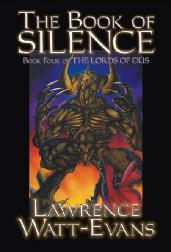
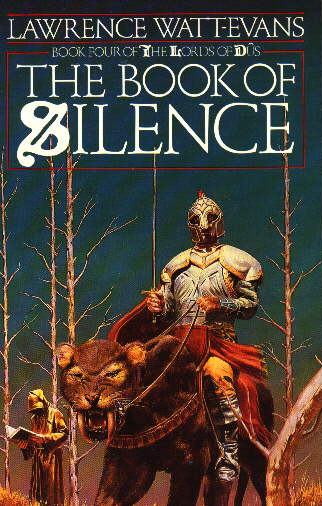
- The cover of the second U.S. edition. (To the right; click on the cover image to see it full-size.)
- Online booksellers I know to be offering it, including the publisher.
- An explanation of how I came to write the story in the first place.
- The opening of the first chapter, to serve as a teaser.
- A complete publishing history of The Book of Silence.
- A FAQ about the series.
- A page for The Lure of the Basilisk, the first book in the series,
- A page for The Seven Altars of Dusarra, the second book in the series,
- A page for The Sword of Bheleu, the third book in the series,
- A page about the series and the four-in-one hardcover omnibus The Lords of Dûs.
- A link to Wildside Press, the current publisher.
- An assortment of exits.
Eventually I may add more stuff, but for now that's it.
Click here to return to  the top of the page.

Origins
The first and most obvious source for The Book of Silence was simply the need to finish up the series and tie up everything I had set up in the first three volumes. I always knew I was going to end the series with the events of Chapter Twenty-Eight -- I won't be more specific in case you haven't read it yet. In the very earliest version, believe it or not, that was just going to be an epilogue tacked onto the end of the planned collection of short stories.
When I revamped the whole project to be mostly novels, I decided that this ending, and the story "The Final Quest" that would have led up to it, should be combined with the unwritten story "Return to Dûsarra," which was to have tied up all the loose ends from "City of the Seven Temples," such as dealing with the cult of Aghad. The two stories blended nicely, becoming what wound up as Chapters Five through Twenty-Eight of The Book of Silence.
And Chapters Twenty-Nine and Thirty were added when Lester del Rey pointed out that ending the series with Chapter Twenty-Eight would be a really bad idea -- bad enough that he wouldn't buy the novel if I stopped there. That was a very, very convincing argument.
So those are the sources in my own plans for The Book of Silence, but there was another source for the whole series that had been just background before, but came to the fore in this volume. I refer to the works of Robert W. Chambers and Ambrose Bierce, specifically the collection The King in Yellow and the short story "An Inhabitant of Carcosa."
This all starts with the Bierce story. "An Inhabitant of Carcosa," written in 1887, describes a citizen of the great city of Carcosa who finds himself in an unfamiliar place that he eventually recognizes as the ruins of Carcosa, where he finds his own gravestone. It's a nice little ghost story that caught the fancy of several later writers, most notably Robert W. Chambers, who in 1895 published a collection of short stories under the title The King in Yellow. Several of the stories in the collection, though not all of them, were tied together by mention of certain mysterious objects, apparently all related, chief among them a blasphemous, madness-inducing play entitled "The King in Yellow" and a strange symbol called the Yellow Sign.
And the play, "The King in Yellow," is set in Carcosa, and mentions several of the names Bierce invented for his story. We get tantalizing hints of the play's setting, characters, and content, but never anything even remotely resembling an actual explanation.
Right from the very start, I had borrowed Chambers' King in Yellow as my mysterious mentor figure, the Forgotten King; as the series progressed, though, I decided that I would borrow considerably more than that. I went through The King in Yellow end to end, noting every detail, every name, every vague hint Chambers gave about the play, the Yellow Sign, and all the rest of it. I assembled all this into my own grand theory of just what the heck was going on, and then used that as the background for my own story. I decided that the play, "The King in Yellow," was set during, and written during, the Eighth Age of my invented chronology, the age when light and darkness were in balance, and that it was the events described in the play that tipped the balance and began the world's long, slow, inevitable slide into despair, destruction, and death.
And I went to great lengths to make my descriptions of the city of Ur-Dormulk match the descriptions Chambers gave of Carcosa -- or rather, what his Carcosa would have been if it were sacked by barbarians, left in ruins as Bierce described, and then rebuilt atop the ruins. The strange deep lakes, the mysterious fogs, an illusion of twin suns, doors sealed with the Yellow Sign...
It was great fun working all this in -- and I'm sure the vast majority of readers never noticed.
Other influences on the series that I should probably mention, as long as I'm at it, would include Michael Moorcock's Elric and his sword Stormbringer; I admit that the Sword of Bheleu owes something to Stormbringer. Fritz Leiber's stories of Fafhrd and the Grey Mouser were part of the inspiration for the crypts of Ur-Dormulk, and specifically for the pillar/fountain, which was my own version of the fountain in Lankhmar's Plaza of Dark Delights.
I put all that together, and The Book of Silence was the result.
Click here to return to the top of the page.
The Book of Silence
Chapter One
The last caravan had departed ten days before, and the next was not expected for at least a fortnight. Skelleth's market lay still and almost empty in the watery sunlight of early spring. No merchants or farmers disturbed its silence, though a few loafers and strolling pedestrians were in sight. On the east side of the square the door of the new Baron's house was closed, indicating that its occupants were not to be disturbed. Garth, one of only two overmen still in Skelleth, sat in the King's Inn, staring out the window at the lifeless market, with nothing to distract him from his own sour mood and gloomy thoughts.
No news had come down from the Northern Waste since the last snows had melted. That meant that Garth had received no word of his family, nor a report about his latest petition to the City Council of Ordunin, asking that his sentence of banishment from the Waste be revoked. He was still an exile from his homeland, stranded in Skelleth for lack of anywhere better to go.
From the overman's point of view Skelleth was not a particularly pleasant place to dwell, but it did have certain advantages. First, it was on the border, the closest human habitation to his native city of Ordunin; therefore, his family could visit him more easily here than elsewhere, and his petitions and letters to the Council could be delivered more quickly.
Second, he was on good terms with the local rulers. Saram, Baron of Skelleth, before being elevated to his present position, had been the closest thing Garth had to a human friend. The Baroness Frima was the only other person who might possibly be considered for that title; Garth had brought her to Skelleth himself, after rescuing her from a sacrificial altar in her native city of Dûsarra. It was he who had introduced Frima to her husband.
Furthermore, the Treasurer and Minister of Trade was the former master trader, Galt of Ordunin, the only other overman still in Skelleth. Garth had brought him down from the Waste to aid in opening trade between Skelleth and Ordunin. That trade was flourishing now, despite the fact that Galt, like Garth, was under sentence of exile.
Third, although the local populace did not, in general, like or trust Garth, it had learned to accept his presence. The people of other human towns might not be so accommodating. Three centuries had passed since the Racial Wars between human and overman had dwindled away to nothing, but hatred, Garth knew, could linger long after its cause was forgotten.
Fourth, at least at the moment, Skelleth was at peace, and that was an increasingly rare distinction. Although the news from the lands to the south and east and west tended to be muddled and sometimes contradictory, Garth knew well that most of the world was at war. No one, including the Eramman barons themselves, seemed to have a clear idea which side any given baron was on in any given war, yet by all accounts that uncertainty had not impeded the fighting one whit. The greater wars provided the excuse for settling old border squabbles or for simple raiding and looting. The civil war in Eramma, begun almost three years earlier when the Baron of Sland rebelled against the High King at Kholis and declared him to be a false king and foul usurper, had settled down into an apathetic lack of cooperation after Sland had been defeated in a long and messy battle. The war between Eramma and Orûn, which had been launched by the opportunistic King of Orûn in hopes of taking advantage of Eramma's seeming dissolution, appeared to have reached a bloody stalemate along a front somewhere to the southeast of Skelleth. Despite the justification of an ancient border dispute, the war was not popular in Orûn and had created such discontent that there were now rumors of impending civil war in that land as well.
Vague reports came in of wars in the western realm of Nekutta, though no one seemed to know who was fighting whom, and no word at all reached Skelleth from Mara, Amag, Tadumuri, Yesh, or the other lands of the far south.
A possible fifth reason for Garth to stay was a result of the fact that Skelleth was peaceful and in a far happier state under Saram than it had ever been under his predecessor. With so many of the world's trade routes disrupted by war and insurrection, Skelleth's very worthlessness had helped to make it a center of commerce. No conqueror in his right mind would bother with so desolate a piece of land, so far from all the traditional caravan roads; that left Saram and his patchwork government free to pursue untraditional trade wholeheartedly and unhindered. The merchants of Skelleth, with their lord's active encouragement, dealt impartially with the men of Eramma, the overmen of the Northern Waste, and the mixed society of the Yprian Coast. With no assets but peace, a willingness to trade, and a manageable location, the town had grown prosperous for the first time in mortal memory.
It had also, in Garth's opinion, grown placid and boring.
Click here to return to the top of the page.
Publishing History:
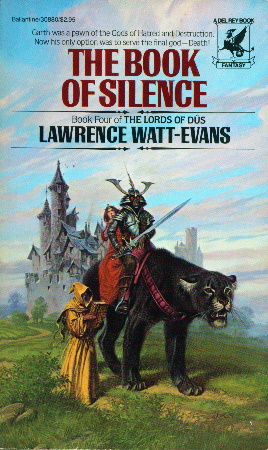
First published January 1984 by Del Rey Books, ISBN 0-345-30880-4. Cover art by Darrell K. Sweet. Del Rey produced at least four additional printings with this cover; ISBN changed with each price increase. The fourth printing, in April 1987, and the fifth printing, in September 1988, had minor changes to the cover.
Second edition July 2002 by Wildside Press, ISBN 1-58715-656-3, as a print-on-demand trade paperback. Cover art by Dalmazio Frau . This edition includes two historical appendices not found in the Del Rey edition.
The novel is also included in the four-in-one hardcover omnibus "Lords of Dus", Wildside Press, ISBN 1-58715-665-2.
The eBook edition was first released in October 2005.
-
Foreign editions:
- British edition published September 1987 by Grafton Books, ISBN 0-586-07152-0. Cover art by Kevin Tweddell.
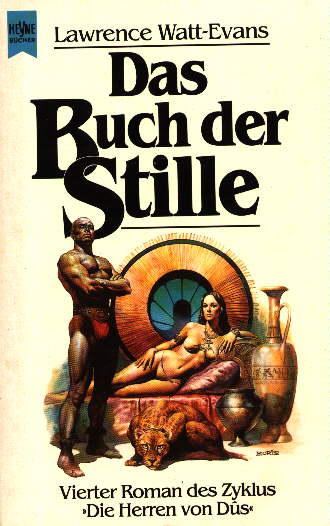
- German edition, Das Buch der Stille, published 1988 by Wilhelm Heyne Verlag, ISBN 3-453-01019-1. Translated by Joachim Pente. Map redrawn by Christine Goebel. Presented by Wolfgang Jeschke. Cover art by Boris Vallejo.
- Spanish rights were sold to Editorial Timun Mas, January 1991, but I am not aware that a Spanish edition was ever published.
- British edition published September 1987 by Grafton Books, ISBN 0-586-07152-0. Cover art by Kevin Tweddell.
If you know of any other editions, please e-mail me!
Click here to return to the top of the page.
Frequently-Asked Questions about The Book of Silence
Okay, this isn't really about The Book of Silence itself; I'm providing...
Frequently-Asked Questions about "The Lords of Dus"
- 1. The single most-often asked question: Will I ever write any more about Garth?
- I honestly don't know. I did plot a fifth novel, back in 1983, but Del Rey never expressed any interest in it, so I never wrote it. I have no plans to do so. However, if Asimov could write more Foundation stories twenty or thirty years later, I'm not about to rule out writing more about Garth.
The remaining questions are all things that might be answered in that fifth volume if I ever wrote it; if you don't want to take even that one-in-a-million chance that I'll be giving away secrets you don't want to know, stop here.
- 2. Will Garth be accepted back into his homeland? He was an outcast at the end of the series.
- Not easily, but eventually.
- 3. Were all the members of Aghad's following dead?
- No. Dozens survived, scattered across the continent and disorganized by the loss of their central temple. They would make sporadic attempts to regroup and to avenge themselves on Garth.
- 4. What changes have occurred in Garth's world as a result of the destruction of the Fifteen Gods?
- The lesser gods, the Arkhein, who survived, suddenly find themselves proportionately more powerful, and for a few years take the opportunity to interfere in human affairs more than before. Gradually, a new balance emerges and the gods become less whimsical once more.
Also, the laws of magic have changed. Much magic depended upon various gods, and therefore no longer works. Science, which really didn't work very well when the gods could change the rules at any time, does work--at least, when the Arkhein don't interfere.
Having the cycle of time broken, however, probably has the greatest effect on people. Under P'hul, everything anyone attempted was doomed to eventual slow failure. Under Bheleu, everything was destined to end in disaster. With the Dus gone and the Ages ended, this sort of predestination isn't there; plans can work or not work according to how well they were devised, or ordinary dumb luck. This means that the established order, which had decayed under P'hul and been largely destroyed by war under Bheleu, can finally be replaced by new organizations.
What those new organizations would be I can't really say; I hadn't worked out all the details yet. I suspect that the trading empire that Garth started at Skelleth would become a major power, that the Yprian invaders in Nekutta would become another, and that Eramma would fall apart into several small countries.
- 5. Will Frima be accepted as Baroness of Skelleth?
- Yes, eventually, because she has Garth with her to enforce her claim, and is pregnant with an heir. It would take some fighting to establish her position, however.
- 6. Will Garth achieve the immortal fame he has been seeking?
- No, not really, because nothing is truly immortal. He has, however, made changes enough in the world to content him, and will be remembered for a very long time indeed.
- 7. ??? Send me questions right here...
- And maybe I'll answer them.
Click here to return to the top of the page.

That's it; here's your list of handy exits:
The Misenchanted Page
Front Page | Main Site | E-mail me!